<?xml version="1.0"?>
<!DOCTYPE html PUBLIC "-//W3C//DTD XHTML 1.1 plus MathML 2.0//EN" "http://www.w3.org/TR/MathML2/dtd/xhtml-math11-f.dtd" [
  <!ENTITY mathml "http://www.w3.org/1998/Math/MathML">
]>
<html xmlns="http://www.w3.org/1999/xhtml">
<head>
  <title>1.2 Numbers</title>
  <link rel="stylesheet" type="text/css" href="../calculus.css" />
  <link rel="stylesheet" type="text/css" href="../mathml.css" />
<!-- Meta tag goes here -->
</head>
<body>
<table width="100%" border="0" cellspacing="0" cellpadding="0">
  <tr>
    <td class="navbar">
      <p>
      <a href="http://ocw.mit.edu/OcwWeb/Mathematics/18-013ASpring-2005/Readings/index.htm">Home</a>
      |
      <a href="../index.xhtml">18.013A</a>
      |
      <a href="contents.xhtml">Chapter 1</a>
      </p>
    </td>
    <td class="navbar">&nbsp;&nbsp;&nbsp;&nbsp;</td>
    <td class="navbar">
      <p class="text-right">
      <a href="../tools/contents.xhtml">Tools</a>
      &nbsp;&nbsp;&nbsp;&nbsp;
      <a href="../glossary_notations/contents.xhtml">Glossary</a>
      &nbsp;&nbsp;&nbsp;&nbsp;
      <a href="../word_index/contents.xhtml">Index</a>
      &nbsp;&nbsp;&nbsp;&nbsp;
      <a href="contents.xhtml">Up</a>
      &nbsp;&nbsp;&nbsp;&nbsp;
      <a href="section01.xhtml">Previous</a>
      &nbsp;&nbsp;&nbsp;&nbsp;
      <a href="section03.xhtml">Next</a>
      </p>
    </td>
  </tr>
  <tr>
    <td colspan="3">
      <hr />
    </td>
  </tr>
</table>
<h2>1.2 Numbers</h2>
<p>
<strong>We start with the basic concept of a number. The Natural Numbers, denoted as
<span class="math-inline-bold">
    <math display="inline" xmlns="&mathml;">
      <mi>&#x2115;</mi>
    </math>
  </span>, </strong>
are the numbers 1,2,3,... These are closed under Addition.
</p>
<p>
<strong>A set that can be put in <a href="definition01.xhtml" class="doclink">correspondence</a> 
  with
<span class="math-inline-bold">
    <math display="inline" xmlns="&mathml;">
      <mi>&#x2115;</mi>
    </math>
  </span> or a subset of
<span class="math-inline-bold">
    <math display="inline" xmlns="&mathml;">
      <mi>&#x2115;</mi>
    </math>
  </span> is called countable.</strong>
</p>
<p>
Introducing the notion of subtraction makes us enlarge 
<span class="math-inline-normal">
  <math display="inline" xmlns="&mathml;">
    <mi>&#x2115;</mi>
  </math>
</span>
 to get the
<strong>Integers, denoted as
<span class="math-inline-bold">
    <math display="inline" xmlns="&mathml;">
      <mi>&#x2124;</mi>
    </math>
  </span>, </strong>
positive or negative or 0, so that our numbers are closed under the operation of substraction.
</p>
<p>
<strong>Exercise 1.1 Is
<span class="math-inline-bold">
    <math display="inline" xmlns="&mathml;">
      <mi>&#x2124;</mi>
    </math>
  </span> countable? <a href="exercise01.xhtml" class="doclink">Solution</a>
</strong>
</p>
<p>
<span class="math-inline-normal">
  <math display="inline" xmlns="&mathml;">
    <mi>&#x2124;</mi>
  </math>
</span>
 is closed under multiplication; which is to say that the product of two integers is an integer.
</p>
<p>
To obtain a set of numbers closed under Division: we must enlarge 
<span class="math-inline-normal">
  <math display="inline" xmlns="&mathml;">
    <mi>&#x2124;</mi>
  </math>
</span>
 to get the
<strong>Rational Numbers
<span class="math-inline-bold">
    <math display="inline" xmlns="&mathml;">
      <mi>&#x211A;</mi>
    </math>
  </span>,</strong>
which are fractions of the form 
<span class="math-inline-normal">
  <math display="inline" xmlns="&mathml;">
    <mrow>
      <mfrac>
        <mi>a</mi>
        <mi>b</mi>
      </mfrac>
    </mrow>
  </math>
</span>
 where 
<span class="math-inline-normal">
  <math display="inline" xmlns="&mathml;">
    <mi>a</mi>
  </math>
</span>
 is in 
<span class="math-inline-normal">
  <math display="inline" xmlns="&mathml;">
    <mi>&#x2124;</mi>
  </math>
</span>
 and 
<span class="math-inline-normal">
  <math display="inline" xmlns="&mathml;">
    <mi>b</mi>
  </math>
</span>
 is in 
<span class="math-inline-normal">
  <math display="inline" xmlns="&mathml;">
    <mi>&#x2115;</mi>
  </math>
</span>
.
</p>
<p>
<strong>Exercises:</strong>
</p>
<p>
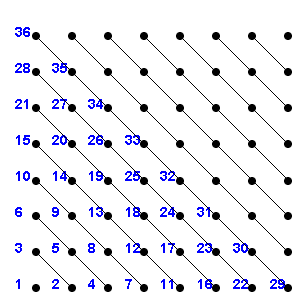
<strong>1.2 Is
<span class="math-inline-bold">
    <math display="inline" xmlns="&mathml;">
      <mi>&#x211A;</mi>
    </math>
  </span> countable?</strong>
(See picture for hint.)
<a href="exercise02.xhtml" class="doclink">
  <strong>Solution</strong>
</a>
</p>
<p class="text-center">
<img src="images/countable_q.gif" alt="figure" width="300" height="300" />
</p>
<p>
<strong>1.3 Prove or disprove: a countable set of countable sets is countable. <a href="exercise03.xhtml" class="doclink">Solution</a>
</strong>
</p>
<p>
<strong>Decimal form of numbers</strong>
</p>
<p>
The numbers between 0 and 1 can each be represented as a decimal point followed by an infinite string of digits, each digit being one of 1, 2, 3, ..., 9, 0.
</p>
<p>
Rational numbers repeat themselves endlessly after some point: (for example 1 / 4 is .250* or also .249* where the star means that you repeat the starred digit endlessly) 1 / 3 is .3*, 1 / 7 = .(142857)*, 57 / 100 = .570*.
</p>
<p>
Irrational numbers do not do so.
<br />
</p>
<p>
<strong>Exercises:</strong>
</p>
<p>
<strong>1.4 Prove that rational numbers repeat the same finite sequence of digits 
  endlessly, and that irrational numbers do not. <a href="exercise04.xhtml" class="doclink">Solution</a>
</strong>
</p>
<p>
<strong>1.5 Are there non-rational decimal digit sequences? <a href="exercise05.xhtml" class="doclink">Solution</a>
</strong>
</p>
<p>
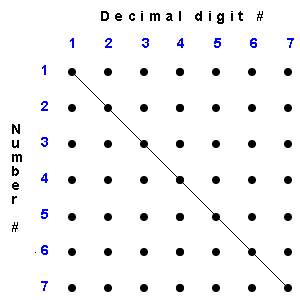
<strong>1.6 Are all such sequences countable? </strong>
(See picture for hint.)
<strong>
  <a href="exercise06.xhtml" class="doclink">Solution</a>
</strong>
</p>
<p class="text-center">
<img src="images/countable_r.gif" alt="figure" width="300" height="300" />
</p>
<p>
<strong>A number which differs from the number in the k-th position 
  on the list in its k-th decimal digit, cannot be in any position on the list 
  of numbers!</strong>
</p>
<p>
<strong>Algebraic numbers</strong>
are solutions to polynomial equations, with integer coefficients.
</p>
<p>
<strong>Exercise 1.7 Are algebraic numbers countable? <a href="exercise07.xhtml" class="doclink">Solution</a>
</strong>
</p>
<p>
The
<strong>Real Numbers
<span class="math-inline-bold">
    <math display="inline" xmlns="&mathml;">
      <mi>&#x211D;</mi>
    </math>
  </span>
</strong>
are
<strong>all distinct infinite sequences of digits, 
  having a sign and a finite number of digits in front of the decimal point.</strong>
</p>
<p>
You can add subtract multiply and divide them except dividing by 0 is not allowed.
</p>
<p>
<strong>Are there other sets that we might dignify by calling numbers?</strong>
</p>
<p>
<strong>Yes! There are &quot;Numbers mod
<span class="math-inline-bold">
    <math display="inline" xmlns="&mathml;">
      <mi>x</mi>
    </math>
  </span> &quot;. These are remainders of
<span class="math-inline-bold">
    <math display="inline" xmlns="&mathml;">
      <mi>&#x2124;</mi>
    </math>
  </span> or
<span class="math-inline-bold">
    <math display="inline" xmlns="&mathml;">
      <mi>&#x211A;</mi>
    </math>
  </span> or
<span class="math-inline-bold">
    <math display="inline" xmlns="&mathml;">
      <mi>&#x211D;</mi>
    </math>
  </span> obtained when you divide by
<span class="math-inline-bold">
    <math display="inline" xmlns="&mathml;">
      <mi>x</mi>
    </math>
  </span>.</strong>
</p>
<p>
<strong>There are also complex numbers, which form the set
<span class="math-inline-bold">
    <math display="inline" xmlns="&mathml;">
      <mi>&#x2102;</mi>
    </math>
  </span>. These are expressions of the form
<span class="math-inline-bold">
    <math display="inline" xmlns="&mathml;">
      <mrow>
        <mi>a</mi>
        <mo>+</mo>
        <mi>i</mi>
        <mi>b</mi>
      </mrow>
    </math>
  </span> where
<span class="math-inline-bold">
    <math display="inline" xmlns="&mathml;">
      <mrow>
        <msup>
          <mi>i</mi>
          <mn>2</mn>
        </msup>
        <mo>=</mo>
        <mo>&#x2212;</mo>
        <mn>1</mn>
      </mrow>
    </math>
  </span>,
<span class="math-inline-bold">
    <math display="inline" xmlns="&mathml;">
      <mi>a</mi>
    </math>
  </span> and
<span class="math-inline-bold">
    <math display="inline" xmlns="&mathml;">
      <mi>b</mi>
    </math>
  </span> are in
<span class="math-inline-bold">
    <math display="inline" xmlns="&mathml;">
      <mi>&#x211D;</mi>
    </math>
  </span>, and multiplication and division are as in
<span class="math-inline-bold">
    <math display="inline" xmlns="&mathml;">
      <mi>&#x211D;</mi>
    </math>
  </span> with the additional rule above.</strong>
</p>
<p>
<a href="comment01.xhtml" class="doclink">
  <strong>Comment - More on Complex Numbers</strong>
</a>
</p>
<table width="100%" border="0" cellspacing="0" cellpadding="0">
  <tr>
    <td>
      <hr />
    </td>
  </tr>
  <tr>
    <td class="navbar">
      <p class="text-right">
      <a href="contents.xhtml">Up</a>
      &nbsp;&nbsp;&nbsp;&nbsp;
      <a href="section01.xhtml">Previous</a>
      &nbsp;&nbsp;&nbsp;&nbsp;
      <a href="section03.xhtml">Next</a>
      </p>
    </td>
  </tr>
</table>
</body>
</html>