|
|
||
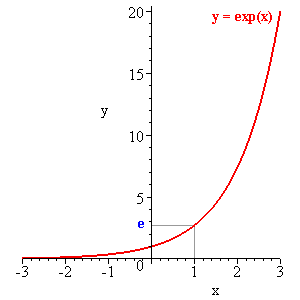
The exponential function, denoted by , is defined by two conditions:
Its value for argument 0 is 1.
And it is its own derivative. Comment
Which means its slope is 1 at 0, which means it is growing there, and so it grows faster and, being its own slope, even faster, as increases. For negative values it never gets to be 0.
If you plot it, and draw a tangent line to it at the argument , that tangent line will stay below it, and hit the axis at .
We can find an expression for as an infinite series of increasing powers of starting with a constant, by using the defining conditions and the fact that the derivative of an integer power is
(If this is not familiar to you take it on faith now; we will prove it later after defining our terms. If you are a beginner at calculus you might find all this mysterious. If so, don't worry, but read the solutions to find out the fundamental properties mentioned below.)
How?
At is 1, which implies that the first or constant term is 1. This term must be the derivative of another term, and by the power derivative formula above, the only possible term that can have 1 as its derivative is .
Similarly the only term which will have x as its derivative is . And so on, and that leads to the conclusion that the general term in the series expression for is ...
Now it is your turn. Finish this sentence by doing the exercises below.
Exercises:
2.1 Figure out the series for and prove it to be so. Solution
2.2 Set up a spreadsheet to compute it up to say the 100th term using your series. Solution
2.3 For , how many terms do you need to get 10 place accuracy? Solution
2.4 Choose a random and compute with a spreadsheet. What do you get? How about ? Solution
The same kind of series solution can be obtained for any function which is its own derivative or has derivative which is a constant multiple say of itself.
This fact allows us to prove the fundamental properties of the exponential function.
These are alternate expressions for and for .
has derivative that is itself, but has value when ;
has value 1 at , but has derivative that is multiplied by itself.
Both of these statements are immediate consequences of the chain rule of differentiation which will be discussed ad nauseam in Chapter 7 .
Given a positive number , we can compute for any integer by multiplying together factors of . We can define to be the inverse function to . And we can define to be the product of m factors of . Thus we can define for any rational .
But how can we define for irrational ?
We can prove that for any rational power that has derivative . Take this on faith for the time being.
We will now define
explicitly so it has this same property.
The condition we need then is that its derivative is itself multiplied by
.
This means that , by the chain rule, would have to have derivative multiplied by the derivative of which is . Thus must have derivative that is times itself.
But that is exactly what the derivative of is. And both of these functions are 1 when is 0.
This means they must have the same power series expansion and therefore must be the same function!
So we have our alternate expression for
and have defined irrational powers in one swell foop. As for
? It's your turn.
Exercise 2.5 State and prove these fundamental properties, ie, expressions for and for . (Hint: what values do they have at ? What are their derivatives? Deduce their series from these statements and identify them.) Solution
Since we have , for any , we can apply it for , using the fact that we can always write , to notice: .
It is customary to define , so that we can write .
The expression is used 99% of the time when is meant. In fact, the main use of the notation is when it is inconvenient to use a superscript, as in typing or machine entry, particularly when has subscripts or superscripts. Computers and spreadsheets use the notation for it, which avoids superscripts but is ugly.
|
|