<?xml version="1.0" encoding="charset=iso-8859-1"?>
<!DOCTYPE html 
     PUBLIC "-//W3C//DTD XHTML 1.0 Transitional//EN"
     "http://www.w3.org/TR/xhtml1/DTD/xhtml1-transitional.dtd">

<html xmlns="http://www.w3.org/1999/xhtml" xml:lang="en" lang="en">

<head>
<title>8.02T - Faraday's Law Visualizations - The Faraday's Law Applet.</title>
<!-- MIT OCW Image Gallery Template Version 1.0: February 18, 2005 - ocw-prod-request@mit.edu -->
<meta http-equiv="Content-Type" content="text/html; charset=iso-8859-1" />
<link href="//ocw.mit.edu/OcwWeb/style/core.css" type="text/css" rel="stylesheet" />
<link rel="home" title="Home" href="//ocw.mit.edu" />
<link rel="home" title="Up" href=http://ocw.mit.edu/OcwWeb/Physics/8-02TFall-2004/Visualizations/detail/faraday.htm />
<link rel="prev" href=../11-fallingcoilapp/11-fallingcoil320.html />
<link rel="next" href=../13-faradayapp02/13-faradayapp02_320.html />


</head>
<body>

<div class="gallerybody">

<p id="gallerynav" class="bodycopy">
&lt;&lt;&lt; <a href=../11-fallingcoilapp/11-fallingcoil320.html accesskey="P" tabindex="1">PREVIOUS</a> 
- <a href=../13-faradayapp02/13-faradayapp02_320.html accesskey="N" tabindex="3">NEXT</a> &gt;&gt;&gt;
</p>

<p><img src=../images/12-faradayslaw320.jpg alt="The Faraday's Law Applet." /> </p>

<p>SUBJECT: <i>The Faraday's Law Applet</i></p>
<p><b>NOTE: You must be connected to the Internet to view this simulation!</b></p>
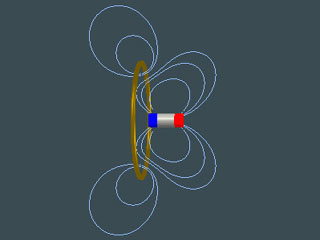
<p>DESCRIPTION: This applet illustrates the electromagnetic interaction between a conducting non-magnetic ring and a magnet, both constrained on a horizontal axis. From the "Actions" menu, you can choose between "Manual Mode" and "Generator Mode". In "Manual Mode", as you move the magnet or the ring (by clicking and dragging), the changing magnetic flux through the ring gives rise to a current which is in a direction such as to oppose the change in flux, as described by Lenz's Law. You can vary the resistance of the ring and the strength of the magnetic dipole moment to see how these parameters affect the resulting field, flux, and current. If the resistance is zero, the change in induced flux in the ring will exactly counter the change in external flux due to the magnet, thus keeping the total flux constant. Increasing the resistance hinders the flow of induced current, resulting in a delay in the response of the ring to the change in external flux, and a corresponding change in total flux. This can be seen in the flux graph as you manipulate the objects.</p>
<p> The "Generator Mode" simulates a simple AC (Alternating Current) generator. The physics are unchanged, but the magnet oscillates sinusoidally, giving rise to a near-sinusoidal current in the ring.</p>
<p>VISUALIZATION: <a href="//web.mit.edu/8.02t/www/802TEAL3D/simulations/faradayslaw.jnlp">Start Simulation</a> (you must have <a href="//java.sun.com/j2se/1.4.2/download.html" target="_blank">Java&#153; J2SE v1.4+ JRE</a> installed. Mac OS X users need the <a href="//www.apple.com/support/downloads/java3dandjavaadvancedimagingupdate.html" target="_blank">Java3D update</a>.)</p>
</div>
</body>
</html>
