Course Description
This course introduces theoretical and practical principles of design of oceanographic sensor systems. Topics include: transducer characteristics for acoustic, current, temperature, pressure, electric, magnetic, gravity, salinity, velocity, heat flow, and optical devices; limitations on these devices imposed by ocean …
This course introduces theoretical and practical principles of design of oceanographic sensor systems. Topics include: transducer characteristics for acoustic, current, temperature, pressure, electric, magnetic, gravity, salinity, velocity, heat flow, and optical devices; limitations on these devices imposed by ocean environments; signal conditioning and recording; noise, sensitivity, and sampling limitations; and standards. Lectures by experts cover the principles of state-of-the-art systems being used in physical oceanography, geophysics, submersibles, acoustics. For lab work, day cruises in local waters allow students to prepare, deploy and analyze observations from standard oceanographic instruments.
Course Info
Course Info
Instructors
Departments
Learning Resource Types
collections
Image Gallery
assignment
Problem Sets
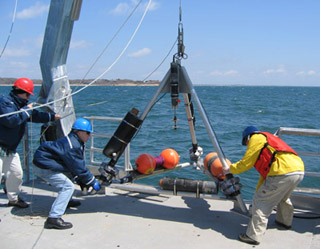
Several students prepare to launch instruments during the 2.693 cruise labs. The tripod frame holds instruments for measuring current, waves and water properties, with an acoustic command release and pop-up recovery float. See the labs page for additional photos. (Photo by Dr. Albert J. Williams 3rd.)