<?xml version="1.0" encoding="charset=iso-8859-1"?>
<!DOCTYPE html 
     PUBLIC "-//W3C//DTD XHTML 1.0 Transitional//EN"
     "http://www.w3.org/TR/xhtml1/DTD/xhtml1-transitional.dtd">

<html xmlns="http://www.w3.org/1999/xhtml" xml:lang="en" lang="en">

<head>
<title>8.02T - Magnetostatics Visualizations - Magnet Oscillating Between Two Coils.</title>
<!-- MIT OCW Image Gallery Template Version 1.0: February 18, 2005 - ocw-prod-request@mit.edu -->
<meta http-equiv="Content-Type" content="text/html; charset=iso-8859-1" />
<link href="//ocw.mit.edu/OcwWeb/style/core.css" type="text/css" rel="stylesheet" />
<link rel="home" title="Home" href="//ocw.mit.edu" />
<link rel="home" title="Up" href=http://ocw.mit.edu/OcwWeb/Physics/8-02TFall-2004/Visualizations/detail/magnetostatics.htm />
<link rel="prev" href=../19_20-EarthandDipNeedle/20-dip_Earth_Closeup_320.html />
<link rel="next" href=../22-teachspinnoforce/22-fod_NoForce_320.html />


</head>
<body>

<div class="gallerybody">

<p id="gallerynav" class="bodycopy">
&lt;&lt;&lt; <a href=../19_20-EarthandDipNeedle/20-dip_Earth_Closeup_320.html accesskey="P" tabindex="1">PREVIOUS</a> 
- <a href=../22-teachspinnoforce/22-fod_NoForce_320.html accesskey="N" tabindex="3">NEXT</a> &gt;&gt;&gt;
</p>

<p><img src=../images/21-Force_320.jpg alt="Magnet Oscillating Between Two Coils." /> </p>

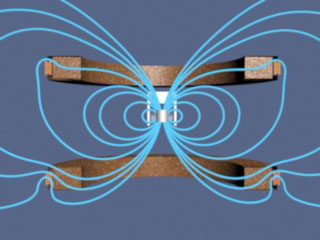
<p>SUBJECT: <i>Magnet Oscillating Between Two Coils</i></p>
<p>DESCRIPTION: This animation shows the magnetic field of a permanent magnet suspended by a spring in the <i>TeachSpin</i>&#8482; apparatus (see <i>TeachSpin&#8482;</i> visualization), plus the magnetic field due to current in the two coils (here we see a &quot;cutaway&quot; cross-section of the apparatus). The magnet is fixed so that its north pole points upward, and the current in the two coils is sinusoidal and 180 degrees out of phase. When the effective dipole moment of the top coil points upwards, the dipole moment of the bottom coil points downwards. Thus, the magnet is attracted to the upper coil and repelled by the lower coil, causing it to move upwards. When the conditions are reversed during the second half of the cycle, the magnet moves downwards.</p>
<p>This process can also be described in terms of tension along, and pressure perpendicular to, the fieldlines of the resulting field. When the dipole moment of one of the coils is aligned with that of the magnet, there is a tension along the fieldlines as they attempt to &quot;connect&quot; the coil and magnet. Conversely, when their moments are anti-aligned, there is a pressure perpendicular to the fieldlines as they try to keep the coil and magnet apart.</p>
<p>VISUALIZATION (<a href="Force_640.mpg">MPG - 4 MB</a>) </p>
</div>
</body>
</html>
