<?xml version="1.0"?>
<!DOCTYPE html PUBLIC "-//W3C//DTD XHTML 1.1 plus MathML 2.0//EN" "http://www.w3.org/TR/MathML2/dtd/xhtml-math11-f.dtd" [
  <!ENTITY mathml "http://www.w3.org/1998/Math/MathML">
]>
<html xmlns="http://www.w3.org/1999/xhtml">
<head>
  <title>6.3 Examples of non Differentiable Behavior</title>
  <link rel="stylesheet" type="text/css" href="../calculus.css" />
  <link rel="stylesheet" type="text/css" href="../mathml.css" />
<!-- Meta tag goes here -->
</head>
<body>
<table width="100%" border="0" cellspacing="0" cellpadding="0">
  <tr>
    <td class="navbar">
      <p>
      <a href="http://ocw.mit.edu/OcwWeb/Mathematics/18-013ASpring-2005/Readings/index.htm">Home</a>
      |
      <a href="../index.xhtml">18.013A</a>
      |
      <a href="contents.xhtml">Chapter 6</a>
      </p>
    </td>
    <td class="navbar">&nbsp;&nbsp;&nbsp;&nbsp;</td>
    <td class="navbar">
      <p class="text-right">
      <a href="../tools/contents.xhtml">Tools</a>
      &nbsp;&nbsp;&nbsp;&nbsp;
      <a href="../glossary_notations/contents.xhtml">Glossary</a>
      &nbsp;&nbsp;&nbsp;&nbsp;
      <a href="../word_index/contents.xhtml">Index</a>
      &nbsp;&nbsp;&nbsp;&nbsp;
      <a href="contents.xhtml">Up</a>
      &nbsp;&nbsp;&nbsp;&nbsp;
      <a href="section02.xhtml">Previous</a>
      &nbsp;&nbsp;&nbsp;&nbsp;
      <a href="section04.xhtml">Next</a>
      </p>
    </td>
  </tr>
  <tr>
    <td colspan="3">
      <hr />
    </td>
  </tr>
</table>
<h2>6.3 Examples of non Differentiable Behavior</h2>
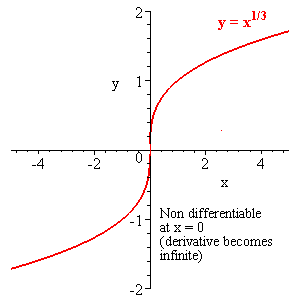
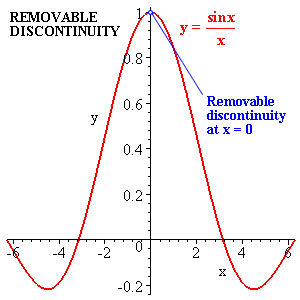
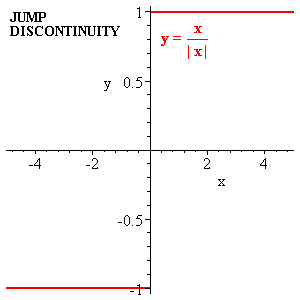
<p>
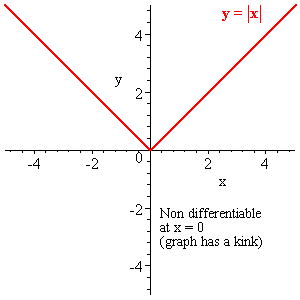
A function which jumps is not differentiable at the jump nor is one which has a cusp, like 
<span class="math-inline-normal">
  <math display="inline" xmlns="&mathml;">
    <mrow>
      <mrow>
        <mo>|</mo>
        <mi>x</mi>
        <mo>|</mo>
      </mrow>
    </mrow>
  </math>
</span>
 has at 
<span class="math-inline-normal">
  <math display="inline" xmlns="&mathml;">
    <mrow>
      <mi>x</mi>
      <mo>=</mo>
      <mn>0</mn>
    </mrow>
  </math>
</span>
.
</p>
<p>
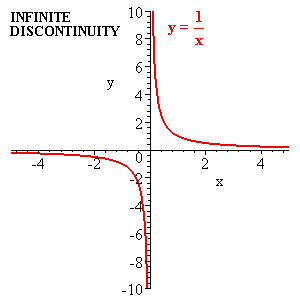
Generally the most common forms of non-differentiable behavior involve a function going to infinity at 
<span class="math-inline-normal">
  <math display="inline" xmlns="&mathml;">
    <mi>x</mi>
  </math>
</span>
, or having a jump or cusp at 
<span class="math-inline-normal">
  <math display="inline" xmlns="&mathml;">
    <mi>x</mi>
  </math>
</span>
.
</p>
<p>
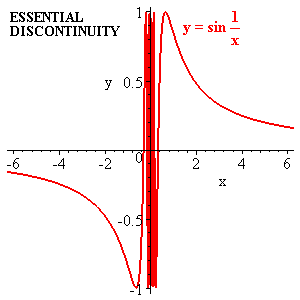
There are however stranger things. The function 
<span class="math-inline-normal">
  <math display="inline" xmlns="&mathml;">
    <mrow>
      <mi>sin</mi>
      <mo>&#x2061;</mo>
      <mrow>
        <mo>(</mo>
        <mrow>
          <mfrac>
            <mn>1</mn>
            <mi>x</mi>
          </mfrac>
        </mrow>
        <mo>)</mo>
      </mrow>
    </mrow>
  </math>
</span>
, for example is singular at 
<span class="math-inline-normal">
  <math display="inline" xmlns="&mathml;">
    <mrow>
      <mi>x</mi>
      <mo>=</mo>
      <mn>0</mn>
    </mrow>
  </math>
</span>
 even though it always lies between -1 and 1. Its hard to say what it does right near 0 but it sure doesn't look like a straight line.
</p>
<p>
If the function 
<span class="math-inline-normal">
  <math display="inline" xmlns="&mathml;">
    <mi>f</mi>
  </math>
</span>
 has the form 
<span class="math-inline-normal">
  <math display="inline" xmlns="&mathml;">
    <mrow>
      <mi>f</mi>
      <mo>=</mo>
      <mfrac>
        <mi>g</mi>
        <mi>h</mi>
      </mfrac>
      <mo>,</mo>
      <mi>f</mi>
    </mrow>
  </math>
</span>
 will usually be singular at argument 
<span class="math-inline-normal">
  <math display="inline" xmlns="&mathml;">
    <mi>x</mi>
  </math>
</span>
 if 
<span class="math-inline-normal">
  <math display="inline" xmlns="&mathml;">
    <mi>h</mi>
  </math>
</span>
 vanishes there, 
<span class="math-inline-normal">
  <math display="inline" xmlns="&mathml;">
    <mrow>
      <mi>h</mi>
      <mo stretchy="false">(</mo>
      <mi>x</mi>
      <mo stretchy="false">)</mo>
      <mo>=</mo>
      <mn>0</mn>
    </mrow>
  </math>
</span>
. However if 
<span class="math-inline-normal">
  <math display="inline" xmlns="&mathml;">
    <mi>g</mi>
  </math>
</span>
 vanishes at 
<span class="math-inline-normal">
  <math display="inline" xmlns="&mathml;">
    <mi>x</mi>
  </math>
</span>
 as well, then 
<span class="math-inline-normal">
  <math display="inline" xmlns="&mathml;">
    <mi>f</mi>
  </math>
</span>
 will usually be well behaved near 
<span class="math-inline-normal">
  <math display="inline" xmlns="&mathml;">
    <mi>x</mi>
  </math>
</span>
, though strictly speaking it is undefined there.
</p>
<p>
We usually define 
<span class="math-inline-normal">
  <math display="inline" xmlns="&mathml;">
    <mi>f</mi>
  </math>
</span>
 at 
<span class="math-inline-normal">
  <math display="inline" xmlns="&mathml;">
    <mi>x</mi>
  </math>
</span>
 under such circumstances to be the ratio of the linear approximation at 
<span class="math-inline-normal">
  <math display="inline" xmlns="&mathml;">
    <mi>x</mi>
  </math>
</span>
 to g to that to 
<span class="math-inline-normal">
  <math display="inline" xmlns="&mathml;">
    <mi>h</mi>
  </math>
</span>
 very near 
<span class="math-inline-normal">
  <math display="inline" xmlns="&mathml;">
    <mi>x</mi>
  </math>
</span>
, which means we define 
<span class="math-inline-normal">
  <math display="inline" xmlns="&mathml;">
    <mrow>
      <mi>f</mi>
      <mo stretchy="false">(</mo>
      <mi>x</mi>
      <mo stretchy="false">)</mo>
    </mrow>
  </math>
</span>
 to be 
<span class="math-inline-normal">
  <math display="inline" xmlns="&mathml;">
    <mrow>
      <mi>f</mi>
      <mo>=</mo>
      <mfrac>
        <mrow>
          <mi>g</mi>
          <mo>&#x0027;</mo>
          <mo stretchy="false">(</mo>
          <mi>x</mi>
          <mo stretchy="false">)</mo>
        </mrow>
        <mrow>
          <mi>h</mi>
          <mo>&#x0027;</mo>
          <mo stretchy="false">(</mo>
          <mi>x</mi>
          <mo stretchy="false">)</mo>
        </mrow>
      </mfrac>
    </mrow>
  </math>
</span>
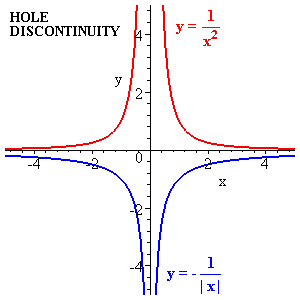
, when, of course the denominator here does not vanish. (If the denominator does vanish and the numerator vanishes as well, you can try to define 
<span class="math-inline-normal">
  <math display="inline" xmlns="&mathml;">
    <mrow>
      <mi>f</mi>
      <mo stretchy="false">(</mo>
      <mi>x</mi>
      <mo stretchy="false">)</mo>
    </mrow>
  </math>
</span>
 similarly as the ratio of the derivatives of these derivatives, etc.)
</p>
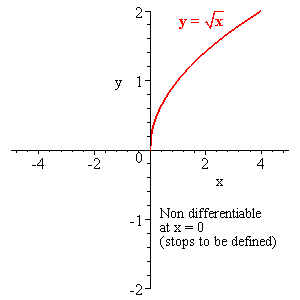
<p>
This kind of thing, an isolated point at which a function is not defined, is called a &quot;removable singularity&quot; and the procedure for removing it just discussed is called
<strong>&quot;l' Hospital's rule&quot;</strong>
.
</p>
<p>
An example is 
<span class="math-inline-normal">
  <math display="inline" xmlns="&mathml;">
    <mrow>
      <mfrac>
        <mrow>
          <mi>sin</mi>
          <mo>&#x2061;</mo>
          <mi>x</mi>
        </mrow>
        <mi>x</mi>
      </mfrac>
    </mrow>
  </math>
</span>
 at 
<span class="math-inline-normal">
  <math display="inline" xmlns="&mathml;">
    <mrow>
      <mi>x</mi>
      <mo>=</mo>
      <mn>0</mn>
    </mrow>
  </math>
</span>
.
</p>
<p class="text-center">
<img src="images/removable.gif" alt="figure" width="300" height="300" />
&nbsp;&nbsp;&nbsp;&nbsp;&nbsp;&nbsp;&nbsp;&nbsp;&nbsp;&nbsp;&nbsp;&nbsp;&nbsp;&nbsp;&nbsp;&nbsp;&nbsp;&nbsp;&nbsp;&nbsp;&nbsp;&nbsp;&nbsp;&nbsp;&nbsp;
<img src="images/jump.gif" alt="figure" width="300" height="300" />
</p>
<p class="text-center">
<img src="images/infinite.gif" alt="figure" width="300" height="300" />
&nbsp;&nbsp;&nbsp;&nbsp;&nbsp;&nbsp;&nbsp;&nbsp;&nbsp;&nbsp;&nbsp;&nbsp;&nbsp;&nbsp;&nbsp;&nbsp;&nbsp;&nbsp;&nbsp;&nbsp;&nbsp;&nbsp;&nbsp;&nbsp;&nbsp;
<img src="images/hole.gif" alt="figure" width="300" height="300" />
</p>
<p class="text-center">
<img src="images/essential.gif" alt="figure" width="300" height="300" />
</p>
<p class="text-center">
&nbsp;
</p>
<p class="text-center">
<strong>Continuous but non differentiable functions</strong>
</p>
<p class="text-center">
&nbsp;
</p>
<p class="text-center">
<img src="images/abs.gif" alt="figure" width="300" height="300" />
&nbsp;&nbsp;&nbsp;&nbsp;&nbsp;&nbsp;&nbsp;&nbsp;&nbsp;&nbsp;&nbsp;&nbsp;&nbsp;&nbsp;&nbsp;&nbsp;&nbsp;&nbsp;&nbsp;&nbsp;&nbsp;&nbsp;&nbsp;&nbsp;&nbsp;
<img src="images/sqrt.gif" alt="figure" width="300" height="300" />
</p>
<p class="text-center">
<img src="images/cubic_root.gif" alt="figure" width="300" height="300" />
</p>
<table width="100%" border="0" cellspacing="0" cellpadding="0">
  <tr>
    <td>
      <hr />
    </td>
  </tr>
  <tr>
    <td class="navbar">
      <p class="text-right">
      <a href="contents.xhtml">Up</a>
      &nbsp;&nbsp;&nbsp;&nbsp;
      <a href="section02.xhtml">Previous</a>
      &nbsp;&nbsp;&nbsp;&nbsp;
      <a href="section04.xhtml">Next</a>
      </p>
    </td>
  </tr>
</table>
</body>
</html>