Course Description
The goal of this class is to prove that category theory is a powerful language for understanding and formalizing common scientific models. The power of the language will be tested by its ability to penetrate into taken-for-granted ideas, either by exposing existing weaknesses or flaws in our understanding, or by …
The goal of this class is to prove that category theory is a powerful language for understanding and formalizing common scientific models. The power of the language will be tested by its ability to penetrate into taken-for-granted ideas, either by exposing existing weaknesses or flaws in our understanding, or by highlighting hidden commonalities across scientific fields.
Course Info
Instructor
Departments
Learning Resource Types
Instructor Insights
menu_book
Open Textbooks
grading
Projects with Examples
Student Work
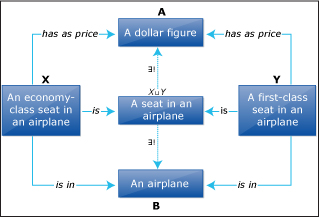
An example of an olog—an abstract means for categorizing the general properties of a system. In this example, the olog provides a conceptual understanding of the system of seat pricing on an airline. (Image by MIT OpenCourseWare.)