Course Description
This course covers interpretations of the concept of probability. Topics include basic probability rules; random variables and distribution functions; functions of random variables; and applications to quality control and the reliability assessment of mechanical/electrical components, as well as simple structures and …
This course covers interpretations of the concept of probability. Topics include basic probability rules; random variables and distribution functions; functions of random variables; and applications to quality control and the reliability assessment of mechanical/electrical components, as well as simple structures and redundant systems. The course also considers elements of statistics; Bayesian methods in engineering; methods for reliability and risk assessment of complex systems (event-tree and fault-tree analysis, common-cause failures, human reliability models); uncertainty propagation in complex systems (Monte Carlo methods, Latin Hypercube Sampling); and an introduction to Markov models. Examples and applications are drawn from nuclear and other industries, waste repositories, and mechanical systems.
Course Info
Instructor
Departments
Learning Resource Types
grading
Exam Solutions
grading
Exams
notes
Lecture Notes
assignment_turned_in
Problem Set Solutions
assignment
Problem Sets
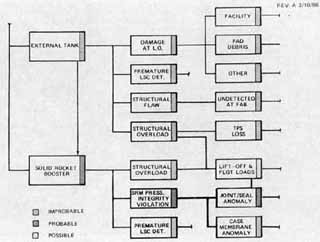
A fault tree from the NASA Accident Analysis Team in Report of the Presidential Commission on the Space Shuttle Challenger Accident. (Image courtesy of NASA.)