Course Description
This course offers a unified analytical and computational approach to nonlinear optimization problems. Unconstrained optimization methods include gradient, conjugate direction, Newton, sub-gradient, and first-order methods. Constrained optimization methods include feasible directions, projection, interior point …
This course offers a unified analytical and computational approach to nonlinear optimization problems. Unconstrained optimization methods include gradient, conjugate direction, Newton, sub-gradient, and first-order methods. Constrained optimization methods include feasible directions, projection, interior point methods, and Lagrange multiplier methods. The curriculum covers convex analysis, Lagrangian relaxation, and nondifferentiable optimization, as well as applications in integer programming. It provides a comprehensive treatment of optimality conditions and Lagrange multipliers. The course also utilizes a geometric approach to duality theory. Finally, applications are drawn from control, communications, machine learning, and resource allocation problems.
Learning Resource Types
grading
Exam Solutions
grading
Exams
notes
Lecture Notes
assignment_turned_in
Problem Set Solutions
assignment
Problem Sets
grading
Supplemental Exam Materials
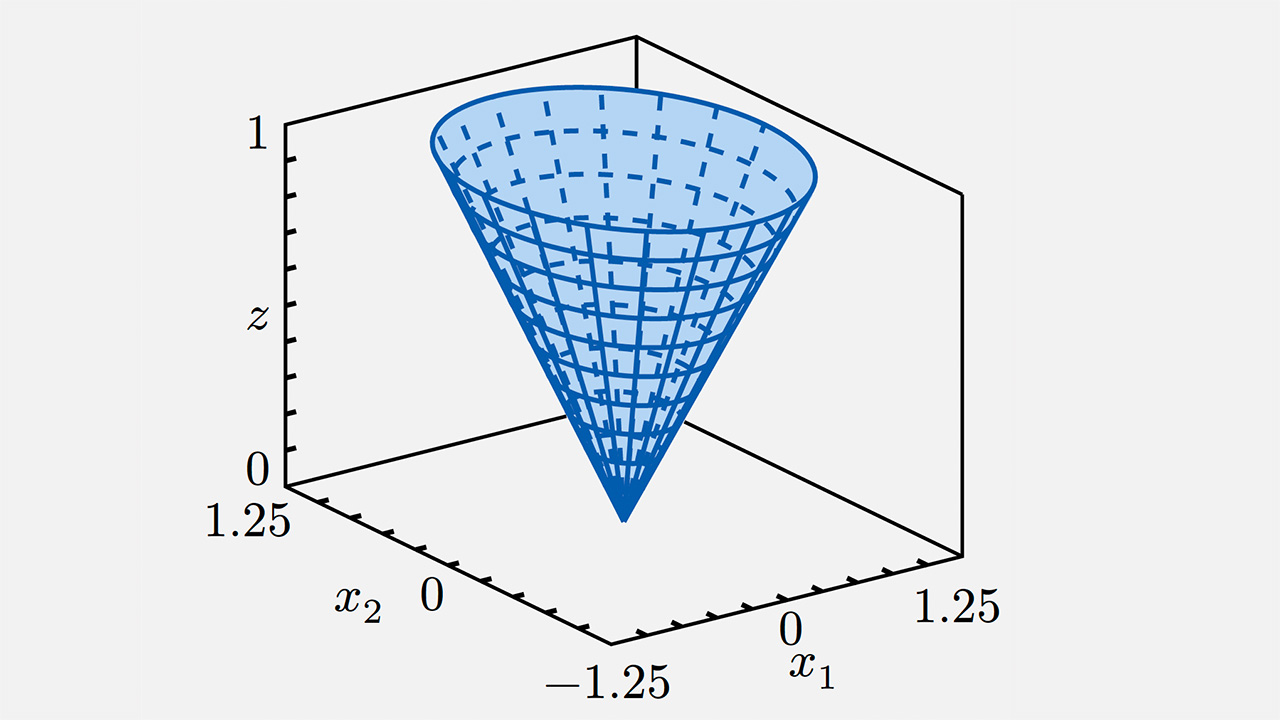
Several problems of interest in engineering and physics can be modeled as cone programs for the Lorentz cone, as shown here, including the design of antenna arrays, the positions of spring systems at rest, and grasp planning in robotics. (Image courtesy of the instructor.)